


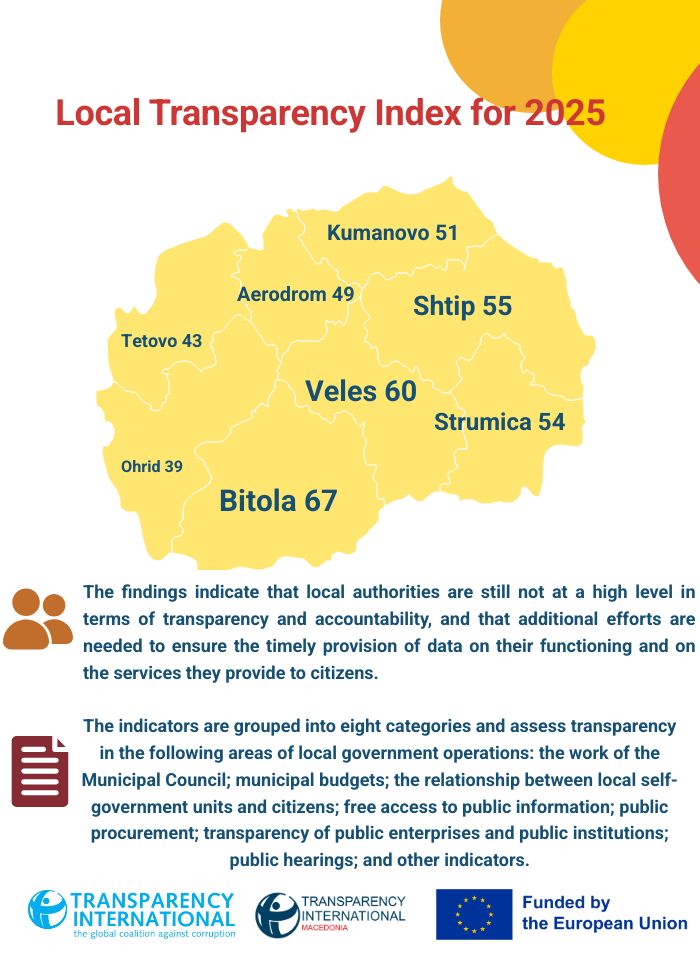
During 2025, Transparency International–Macedonia conducted a pilot assessment of the Local Government Transparency Index, based on the methodology of Transparency International, with the aim of determining how transparent municipalities are towards citizens, how they publish information about their work, how accessible this information is to the public, and in what ways citizens can access both institutions and the services provided by the municipality.
The municipalities were assessed on the basis of a questionnaire consisting of 91 questions covering multiple areas of municipal operations. The sample included the largest municipality by population in each planning region, namely the municipalities of Aerodrom, Bitola, Veles, Kumanovo, Ohrid, Strumica, Tetovo, and Shtip.
This index represents a composite of positive scores obtained from indicators that include an analysis of websites, documents, responses to requests for free access to public information, and direct insight into the functioning of the administration, i.e. service centers, as well as data obtained from other institutions.
The indicators are grouped into eight categories and assess transparency in the following areas of local government operations: the work of the Municipal Council; municipal budgets; the relationship between local self-government units and citizens; free access to public information; public procurement; transparency of public enterprises and public institutions; public hearings; and other indicators.
The findings indicate that local authorities are still not at a high level in terms of transparency and accountability, and that additional efforts are needed to ensure the timely provision of data on their functioning and on the services they provide to citizens.
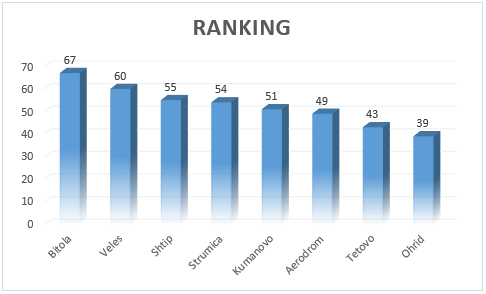
The highest-rated municipality is Bitola with 67 points, followed by Veles with 60, Shtip with 55, Strumica with 54, Kumanovo with 51 points, Aerodrom with 49, Tetovo with 43 points, while the lowest-rated municipality is Ohrid with 39 points. The average score is 52.
Municipalities rarely scored above 60% of the possible points within a given category, with the exception of public procurement, which received the highest scores. The lowest-rated categories were public hearings and public calls, as well as public enterprises and public institutions.
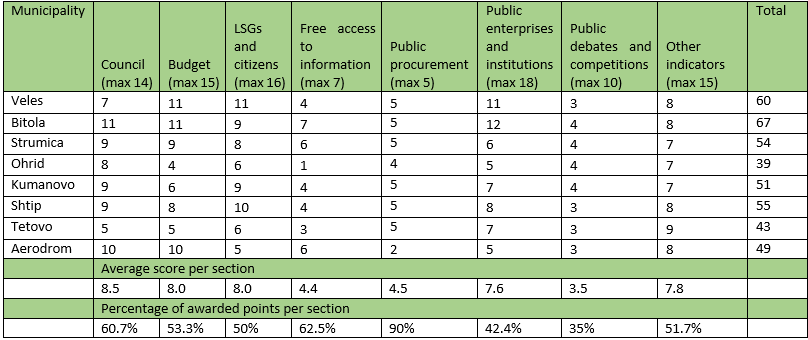
A significant amount of information is missing from municipal websites, making it difficult to form a clear picture of the extent to which municipalities contribute to regional development and how effectively the funds allocated for municipal financing are managed and directed toward activities that positively impact citizens’ quality of life.
The full analysis can be accessed at the following link: https://transparency.mk/wp-content/uploads/2026/01/local_transparency_index_2025.pdf

